


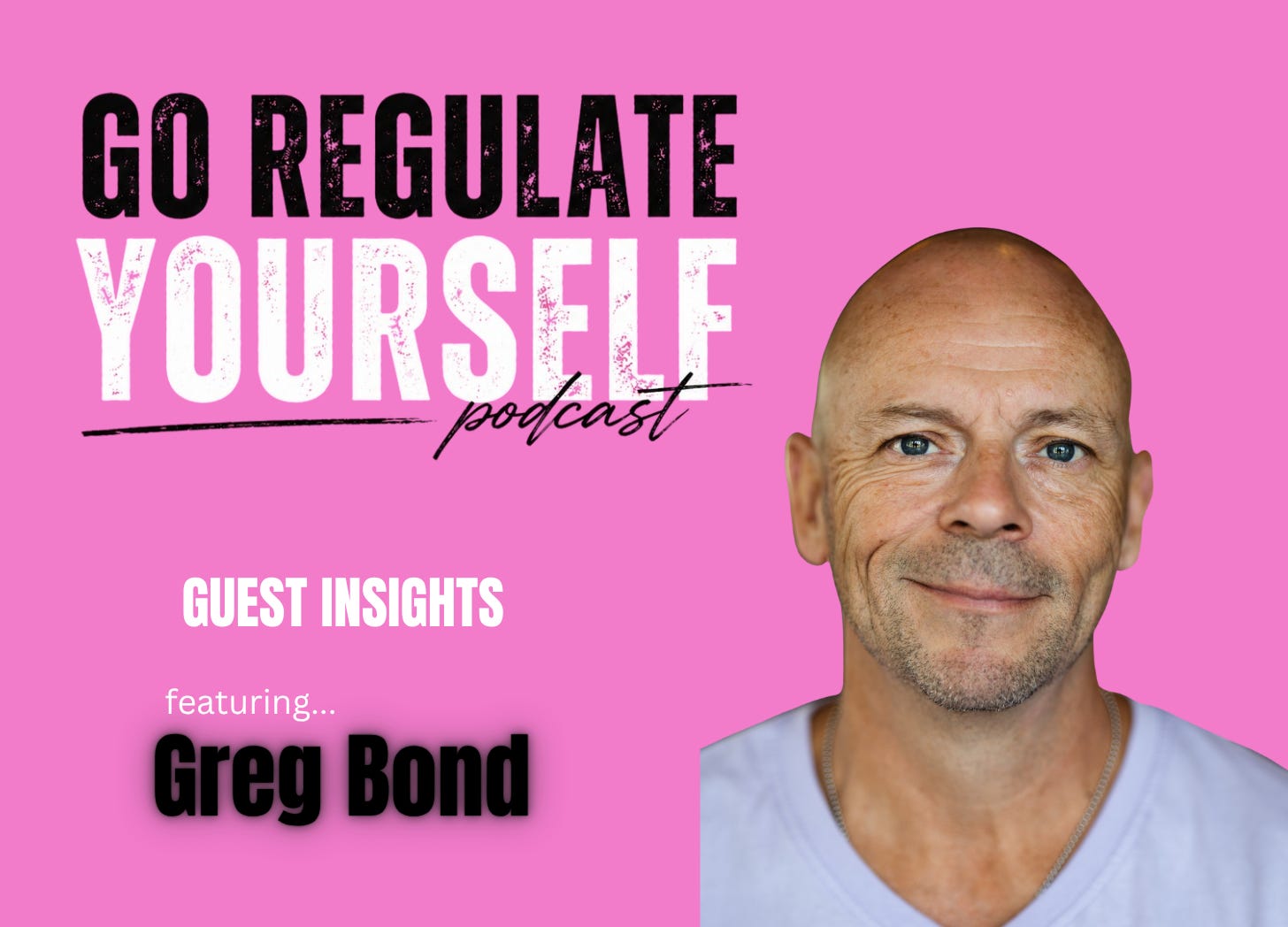
A Little About The Guest.
Greg “Bondzee” Bond is a Canadian author, podcast host, actor, and wellness advocate whose powerful story of trauma, addiction, and redemption has inspired audiences across North America. After witnessing a tragic train accident in 2009, Greg battled PTSD, alcoholism, heartbreak, and personal loss for years before completely transforming his life through sobriety, fitness, the carnivore lifestyle, meditation, and mental wellness practices.
Now 52, Greg has lost over 65 pounds, become a competitive bodybuilder, launched successful business ventures, and hosts the podcast Wellness With Bondzee (formerly Trippin With Bondzee) where he has interviewed musicians, creators, and inspiring guests. He is the author of One Minute Late, a raw and deeply personal memoir about surviving trauma, rebuilding a shattered life, and finding purpose again.
Greg brings authenticity, humor, and hard-earned wisdom to every conversation, making him a compelling guest for podcasts focused on mental health, recovery, resilience, wellness, personal growth, and inspirational life stories.
Find + Connect With Greg Here:
INSTAGRAM | FIND HIS BOOK HERE
The Guest Deep-Dive.
1. You got sober, lost over 60 pounds, and at 52 started competing in bodybuilding. How did sobriety and that physical transformation relate to processing the trauma itself- did one make the other possible?
It’s funny— who would have thought that at 52 years old I’d get sober, lose over 60 pounds, get completely jacked, and step on a bodybuilding stage? Certainly not me.
Back in 2011, my family was at Disney World in Florida. My wife and kids went to see a psychic while I skipped out and went to a bar instead. When I came back, the psychic approached me and said, ‘I know you don’t believe in what I do, but I see amazing things for you when you get sober.’
At the time, I brushed it off. I didn’t believe any of that stuff.
But once I finally got sober years later, my life started changing in ways I never expected. One of the biggest things was finding a sense of closure around the young man who was killed by the train, a traumatic event that haunted me for years.
Oddly enough, another psychic played a role in helping me process that. She knew nothing about my story, yet she brought him up during a session. Whether people believe in that kind of thing or not, it gave me a sense of peace and helped me let go of a lot of pain I had been carrying.
Sobriety gave me the clarity to start healing, and fitness gave me a positive outlet for that healing. Training six days a week, eating clean, and transforming my body ended up transforming my mind as well. For me, they went hand in hand. Getting physically stronger helped me become mentally and emotionally stronger too. The trauma didn’t disappear, but I finally learned how to carry it in a healthier way—and that changed everything.
2. Talk to us about psychedelics. What has been your experience, what have you used, and what was Ayahuasca like for you?
Psychedelics ended up being a very important part of my healing journey. Now, I always tell people that this was my experience, not medical advice, but for me they helped in ways that traditional approaches never could.
I participated in psychedelic-assisted therapy using MDMA and psilocybin, and I’ve also had experiences with DMT and Ayahuasca. Going into it, I wasn’t looking to get high or escape reality. I was looking to heal. I was carrying years of PTSD, depression, unresolved trauma, grief, and emotional baggage that I hadn’t fully processed.
What I found was that these experiences allowed me to look at parts of myself that I had spent years avoiding. They helped me lower the walls I’d built around my emotions and confront things that I didn’t even realize were still affecting me. In many ways, they gave me a different perspective on my life, my pain, and even on myself.
The biggest surprise was how much compassion I developed, not just for other people, but for myself. For years I beat myself up over things that had happened in my life. Psychedelic therapy helped me let go of some of that guilt, anger, and shame and replace it with understanding and acceptance.
Ayahuasca and DMT were probably the most intense experience of them all. It’s difficult to put into words because they felt less like a drug experience and more like a deep journey inward. It forced me to confront things I had buried for years. There were moments that were uncomfortable, emotional, and challenging, but there were also moments of incredible clarity, peace, and insight.
For me, those substances weren’t about seeing crazy visions or having some mystical adventure. It was about healing. It felt like years of emotional weight were finally being unpacked and processed. I walked away with a greater sense of gratitude, purpose, and understanding of who I am. They didn’t specifically focus in on what I dealt with directly but were instrumental into opening my eyes to who and what I was.
Were psychedelics a magic cure? No. The real work still had to be done afterward. I still had to stay sober, exercise, eat properly, work on my mental health, and make better choices every day. But they opened a door for me. They showed me that healing was possible and gave me tools and insights that helped me move forward.
Looking back, psychedelic therapy was one of the most powerful tools I’ve ever used in my recovery. Combined with sobriety, fitness, self-reflection, and a willingness to do the work, it helped me become the person I am today.
3. What did the early days of getting sober actually feel like, day to day? People romanticize ‘breakdown to breakthrough’- but what did this actually look like for you?
The early days of getting sober were a wild transformation. It wasn’t easy, but after the health scare I had, it was actually easier than I expected because I knew I had to make a change.
My first instinct was to lock myself away for a year and avoid every situation that might tempt me. I figured I wouldn’t go to concerts, wouldn’t play golf, and would barely leave the house because just about everything I did revolved around drinking and drugs.
But then I realized that’s not who I am. I didn’t want to spend my life hiding from the world. So instead, I decided to face it head-on. I threw myself to the wolves, so to speak. I went to the concerts. I played the golf. I did the things I normally loved to do, I just did them without alcohol or cocaine.
At first, it was uncomfortable. There were moments when I wondered if I’d still enjoy those experiences without the substances. But week by week, it got easier. Eventually, it stopped feeling like I was missing something and started feeling completely normal.
What surprised me most was how much better life became. Every week seemed a little brighter than the one before. I had more energy, more clarity, and more confidence. I started reconnecting with myself, the version of me that had been buried for years.
I often tell people that sobriety didn’t take my life away; it gave me my life back. Somewhere along the journey, I fell in love with myself again. I stopped merely surviving and started thriving.
4. You described yourself as a ‘macho man’ before, and this showed up as you sabotaging your own healing. Being on the other side now and knowing how important healing and mental health is for men like you- how do you talk about this area now with other men? Is there something you hope to help shift in relation to the stigma around it, so that others can move forward in life like you have?
Yeah, I was definitely one of those macho guys. You know the type… ’I’m fine, I’ll deal with it, I don’t need help.’ Meanwhile, you’re falling apart inside and pretending everything’s under control. That was me for a long time.
What I’ve learned is that keeping everything bottled up doesn’t make you strong, it makes you a pressure cooker. Eventually something has to give. For a lot of men, that shows up as anger, addiction, depression, failed relationships, or just going through life completely disconnected from who they really are.
These days, when I talk to other men, I’m brutally honest about my own journey. I tell them about the trauma, the addiction, the heartbreak, the mistakes, and the years I spent trying to outrun my problems. I don’t sugarcoat it because I think too many men are suffering in silence, believing they’re the only ones struggling.
The truth is, asking for help isn’t weakness. Talking about what you’re carrying isn’t weakness. Going to therapy, working on yourself, facing your demons, that’s not weakness either. That takes courage. Anybody can throw on a tough-guy mask. It takes a real man to take it off.
I think the stigma is slowly changing, but we’ve still got work to do. Too many men are taught to suppress their emotions instead of process them. We’re told to ‘man up’ when what we really need is to open up.
If there’s one thing I hope to help shift, it’s this idea that strength and vulnerability are opposites. They’re not. Some of the strongest men I’ve ever met are the ones willing to admit they’re struggling and willing to do the work to get better.
I’m not standing here as some perfect guy who’s got life all figured out. I’m just a guy who finally stopped running from his problems and started facing them. And I can tell you from experience that life gets a whole lot better when you do.
If my story helps even one man put down the mask, ask for help, and start healing, then sharing it has been worth it.
5. If you could go back and say something to yourself in the weeks after that happened, what would it be?
I have a very simple answer to that. I would tell myself to seek the proper help, trust the process, and stop trying to be so macho about everything.
For years, I had the mindset that I could handle it on my own. I thought admitting I was struggling was a sign of weakness, so I bottled everything up and tried to carry the weight by myself.
Looking back, I realize that was one of the biggest mistakes I made. It’s okay to admit you’re not okay. It’s okay to ask for help. In fact, it takes far more courage to reach out than it does to suffer in silence.
If I could sit down with that younger version of myself in the weeks after it happened, I’d tell him that he doesn’t have to carry the burden alone. There are people who want to help, people who understand, and there are tools and resources that can make the journey easier.
Healing isn’t about being tough enough to endure the pain by yourself. It’s about being strong enough to accept help and trust that, with time and support, things can get better.
6. For someone who’s carrying something similar- a moment they can’t undo, something that feels too heavy to escape- what do you want them to know?
What I want people to know is that no matter how heavy it feels right now, your story isn’t over.
We all carry things we’re not proud of. We all have moments we wish we could undo, mistakes we regret, or pain that feels impossible to escape. I know what that’s like. I’ve carried trauma, heartbreak, loss, addiction, and experiences that haunted me for years.
The biggest lesson I’ve learned is that while you can’t change what happened, you can change what happens next. You don’t have to let your worst moment become your identity. You don’t have to let your past dictate your future.
Healing isn’t about pretending the pain never happened. It’s about facing it, learning from it, and refusing to let it define the rest of your life. And that doesn’t happen overnight. It happens one choice at a time, one day at a time.
If you’re carrying something heavy today, be patient with yourself, but don’t give up on yourself. Ask for help if you need it. Keep moving forward, even if it’s only one small step at a time.
There is another chapter waiting to be written. The person you are today does not have to be the person you are a year from now.
I’m living proof of that. I went from being lost, overweight, unhealthy, and stuck in destructive habits to becoming sober, transforming my body, rebuilding my confidence, and creating a life I’m genuinely proud of.
Sometimes the very thing that breaks you ends up becoming the thing that builds you. When you’re in the middle of the pain, it’s impossible to see that. But if you keep going, keep believing, and keep doing the work, one day you’ll look back and realize that your greatest struggle became the foundation for your greatest growth.
The Podcast Deets.
Imagine being out with friends for a weekend away, having laughs and sharing smores- when suddenly, just a few hours later, you witness a horrific death that stays with you for years to come.
How do you even begin to function? To return to a ‘normal’ life? And what do you do when what you saw continues to replay in your mind over and over again?
Most of us can’t even begin to comprehend what that would look like- but today’s Friday’s with Friends guest knows exactly what it’s like… and he’s about to share every hard and beautiful moment with us.
In this episode, Greg Bond, walks us through one of the most significant moments of his life that completely altered the direction he was headed, and who he was becoming. He shares what happened in those initial moments and in the immediate aftermath, as well as the years that followed.
This conversation is raw, deeply emotional, and incredibly insightful. It moved me to tears- and I know that this will be the episode that sticks with you forever.
So let’s go ahead and dive in, shall we?
137. One Minute Late: Trauma, Addiction + A Fight Back To Life [with Greg Bond]
SUBSTACK | SPOTIFY | APPLE PODCASTS | YOUTUBE